
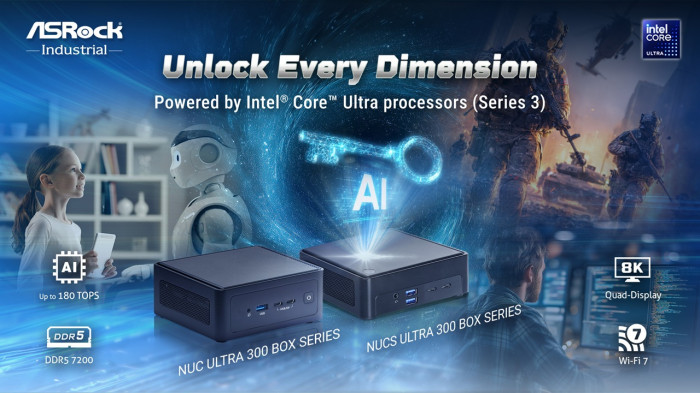
Celebrity Fan Web – ASRock has introduced a new generation of compact desktop systems aimed at high performance and local artificial intelligence workloads. The NUC Ultra 300 Box series combines small form factors with modern Intel processors. The lineup is designed for users seeking AI acceleration without sacrificing connectivity. ASRock positions these systems for professional, edge computing, and advanced desktop use cases.
“Read More : Batman Arkham Asylum hits 60fps on Retroid Pocket 6”
ASRock Introduces NUC Ultra 300 Box Series With AI Focus
ASRock has revealed two new compact PCs under the NUC Ultra 300 Box branding. The series includes the NUC Ultra 300 and the NUCS Ultra 300. Both systems are designed to deliver strong performance in compact enclosures. ASRock emphasizes local AI processing as a core use case.
The two models differ slightly in physical dimensions. The NUCS Ultra 300 measures 117.5 by 110 by 38 millimeters. This makes it shorter than the standard NUC Ultra 300. The NUC Ultra 300 has a height of 49 millimeters. Both systems maintain a compact footprint suitable for desks or embedded installations.
Processor options are consistent across both models. ASRock confirms support for Intel Core Ultra Series 3 processors. These chips integrate CPU, GPU, and NPU components. The design targets workloads that benefit from heterogeneous computing. Local AI inference is a primary focus.
ASRock advertises AI performance of up to 180 TOPS. This figure represents combined performance across processing units. It includes contributions from the NPU, CPU, and integrated graphics. ASRock has not disclosed standalone NPU performance. The combined metric aligns with current industry AI marketing standards.
Memory support is identical on both models. Each system supports up to 128 GB of DDR5 memory. Supported memory speeds reach up to 7,200 megahertz. This capacity targets professional users and demanding multitasking scenarios. Large memory pools are also beneficial for AI workloads.
Both systems support two M.2 solid state drives. One drive connects using four PCIe 5.0 lanes. The second drive connects using four PCIe 4.0 lanes. ASRock notes minimal real world performance differences for most applications.
Connectivity Differences and Pending Availability Details
While core specifications are similar, connectivity differs between the two models. The NUC Ultra 300 offers a more enterprise oriented port selection. It includes one Thunderbolt 4 port for high speed peripherals. Four USB 3.2 Gen 2 ports are also available. Additionally, it features two Ethernet ports.
Both Ethernet ports on the NUC Ultra 300 support data transfer speeds up to 2.5 gigabits per second. This configuration benefits network intensive environments. Dual Ethernet enables redundancy or advanced networking setups. It also suits edge computing and virtualization scenarios.
The NUCS Ultra 300 takes a slightly different approach. It includes four USB 3.2 Gen 2 ports as well. However, it provides only one Ethernet port. This Ethernet port also supports up to 2.5 gigabits per second. The model compensates with expanded display connectivity.
Display outputs on the NUCS Ultra 300 include HDMI 2.1 and DisplayPort 2.1. These standards support high resolution and high refresh rate monitors. The configuration targets users needing advanced display setups. It may appeal to creators or control room environments.
ASRock has not yet published complete specification sheets. Details such as cooling design and power limits remain undisclosed. Information about wireless connectivity has also not been confirmed. These details are expected closer to launch. ASRock typically releases full documentation later.
Pricing information has not been announced. Availability timelines are also pending. ASRock has confirmed both models are in the pipeline. Market release is expected after final specifications are disclosed. Regional availability may vary depending on configuration.
“Read More : Fullkrug joins AC Milan in loan deal from West Ham”
The NUC Ultra 300 Box series reflects continued demand for compact performance systems. AI acceleration is becoming a standard requirement. ASRock’s approach combines modern processors with flexible I O. The dual model strategy allows buyers to choose based on connectivity needs.